How to pray, step by step
The full sunnah method of prayer in order, with the words to say, and how it differs for the imam, the follower and a woman.
Here is the full, best way to pray, in order: from making wudu to saying the final Salam. The way of praying is the same for everyone: a man praying alone, an imam, someone following an imam, and a woman. Only a few small things about hand and foot position are different for a woman, and those are explained at the end.
Before you start
- Make sure you have wudu, your clothes and the floor are clean, your awrah is covered, and you are facing the Qibla.
- Stand with your hands by your sides and a small gap between your feet. Clear your mind and remember you are standing in front of Allah.
- Decide in your heart which prayer you are praying: for example, "I am praying two rak'ahs of Fajr." Saying it out loud too, in Arabic or your own words, is a good habit.
نَوَيْتُ أَنْ أُصَلِّيَ رَكْعَتَي الْفَجْرِ فَرْضَ الْوَقْتِ خَالِصًا لِلّٰهِ تَعَالٰى مُتَوَجِّهًا إِلٰى جِهَةِ الْكَعْبَةِ الشَّرِيفَةِ
Nawaytu an uṣalliya rakʿatay al-Fajri farḍa'l-waqti khāliṣan lillāhi taʿālā mutawajjihan ilā jihati'l-Kaʿbati'sh-sharīfah
I intend to pray the two rak'ahs of Fajr, the obligatory prayer of this time, purely for Allah the Exalted, facing the direction of the noble Kaaba.
One rak'ah, step by step
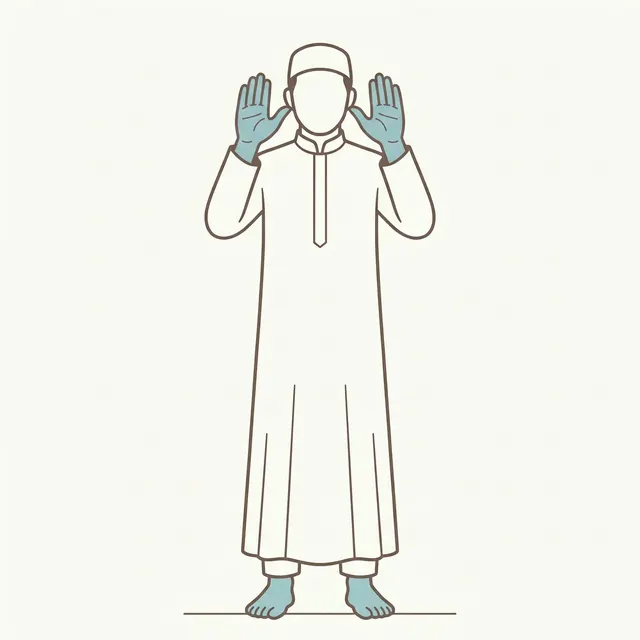
- As you make the intention, raise both hands up to your ears, thumbs touching your earlobes, palms facing the Qibla.
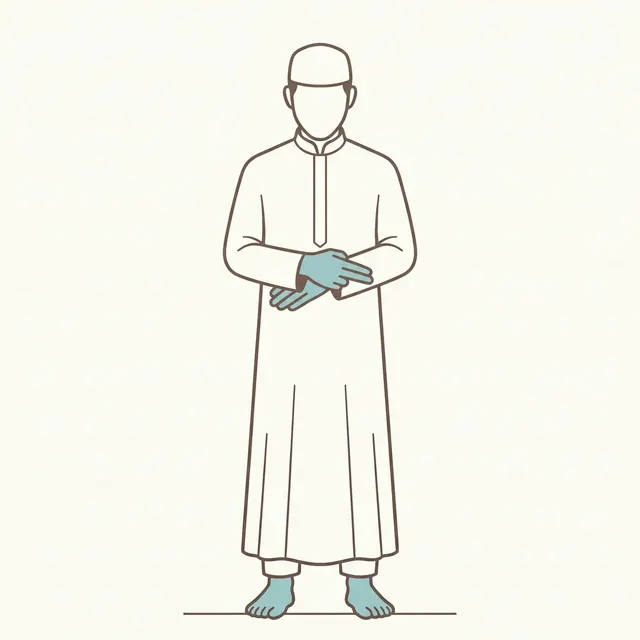
- Say "Allahu Akbar" (the opening Takbir), then fold your hands below your chest, right hand over left. Look at the spot where you'll put your forehead down.
- Quietly say the Thanaa, then the Ta'awwudh, then the Bismillah.
- Recite Surah Al-Fatiha, then another surah: for example, Surah Al-Kawthar.
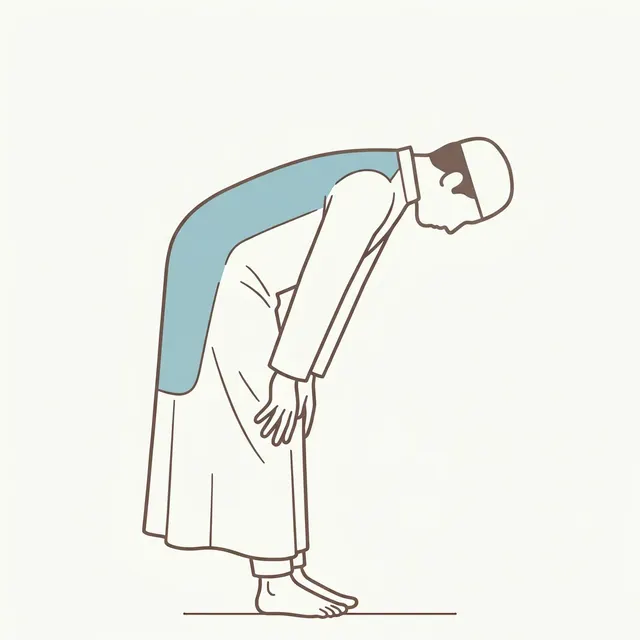
- Say "Allahu Akbar" and bow down (Ruku): knees firm, fingers spread on your knees, back flat, eyes on your feet. Say the tasbih of Ruku quietly.
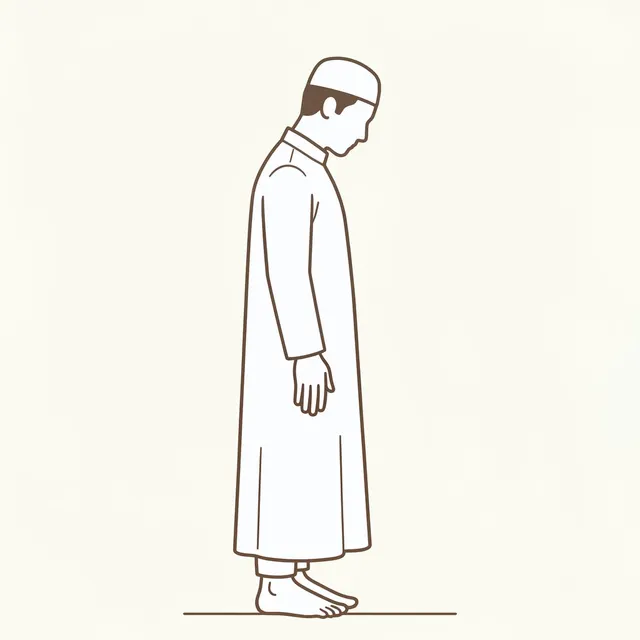
- Come up straight, saying "Sami' Allahu liman hamidah," then "Rabbana lakal hamd," with your hands hanging by your sides.
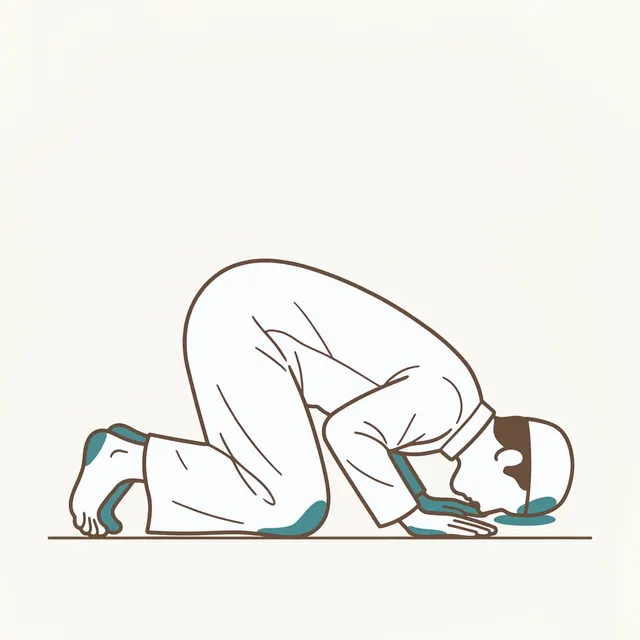
- Say "Allahu Akbar" and go down into Sujood: knees down first, then hands, then nose and forehead, toes pointing towards the Qibla. Say the tasbih of Sujood quietly.
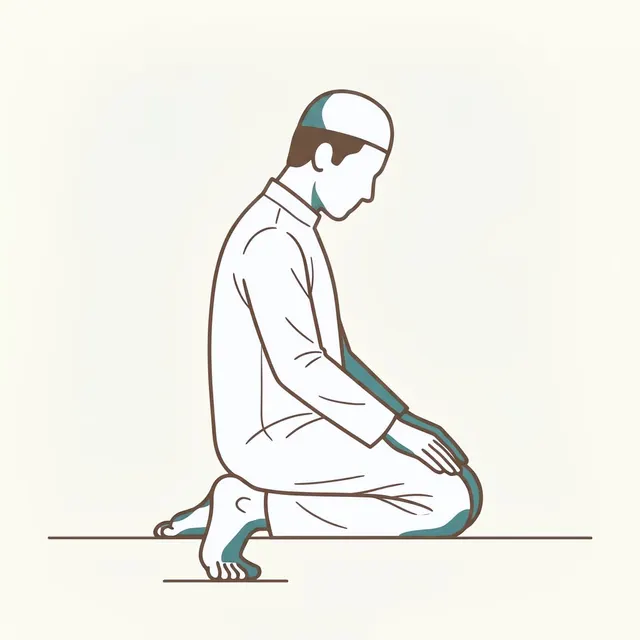
- Say "Allahu Akbar" and sit up for a moment (Jalsa): left foot flat, right foot standing up, hands on your thighs.
- Say "Allahu Akbar" and go down into a second Sujood, the same way.
- Stand back up for the next rak'ah and do it all again.
سُبْحَانَكَ اللَّهُمَّ وَبِحَمْدِكَ وَتَبَارَكَ اسْمُكَ وَتَعَالَى جَدُّكَ وَلا إِلٰهَ غَيْرُكَ
Subḥānaka'llāhumma wa bi-ḥamdika, wa tabāraka'smuka, wa taʿālā jadduka, wa lā ilāha ghayruk
Glory be to You, O Allah, and praise be to You. Blessed is Your name, and exalted is Your majesty, and there is no god besides You.
أَعُوذُ بِاللَّهِ مِنَ الشَّيْطَانِ الرَّجِيم
Aʿūdhu billāhi mina'sh-shayṭāni'r-rajīm
I take refuge in Allah from Shaytan, the accursed.
بِسْمِ اللَّهِ الرَّحْمَنِ الرَّحِيمِ
Bismillāhi'r-Raḥmāni'r-Raḥīm
In the name of Allah, the Most Compassionate, the Most Merciful.
سُبْحَانَ رَبِّيَ الْعَظِيمِ
Subḥāna Rabbiya'l-ʿAẓīm
Glory be to my Lord, the Magnificent.
سَمِعَ اللَّهُ لِمَنْ حَمِدَه / رَبَّنَا لَكَ الْحَمْدُ
Samiʿa'llāhu liman ḥamidah / Rabbanā laka'l-ḥamd
Allah hears the one who praises Him. / Our Lord, all praise is for You.
سُبْحَانَ رَبِّيَ الْأَعْلَى
Subḥāna Rabbiya'l-Aʿlā
Glory be to my Lord, the Most High.
The sunnah way to pray one rak'ah: make your intention, raise your hands to your ears and say Allahu Akbar, fold your hands right over left, quietly say the Thanaa, Ta'awwudh and Bismillah, then read Al-Fatiha and a surah. Say Allahu Akbar as you bow and say the tasbih three times, come up saying 'Allah hears the one who praises Him', then go down to sujood knees first, say the tasbih three times, sit up, and prostrate a second time.
12345678910Finishing the prayer
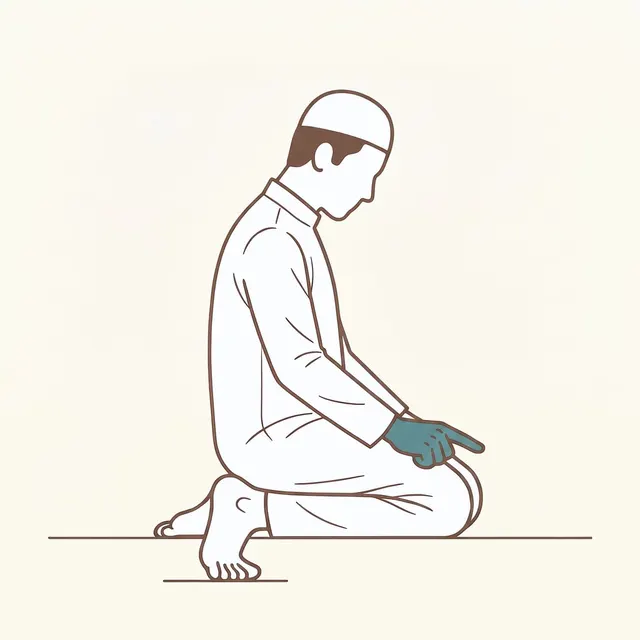
- After the second rak'ah, sit down and recite the Tashahhud. As you say the words about there being only one God, point with your right hand, raising the middle finger and keeping the left hand's fingers down.This is what the source book itself says. It's different from the more commonly taught way of pointing with the index finger, so it's worth checking against the original book.
- In a two-rak'ah prayer, stay sitting and also recite the Durood, then a dua, then say Salam to the right and to the left, and you're done.
- In a prayer with three or four rak'ahs, after the Tashahhud in this first sitting say "Allahu Akbar" and stand straight back up for the next rak'ah. Don't say Durood or dua yet. In these later rak'ahs, recite only Al-Fatiha, without an extra surah.If you do say the Durood there by mistake, do sajdah sahw at the end of the prayer.
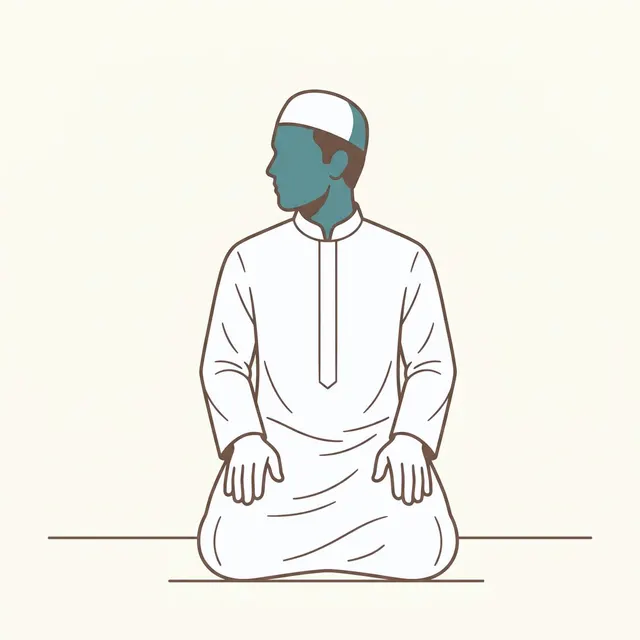
- In that very last sitting, recite the Tashahhud, then the Durood, then the dua, then turn your head right and say Salam, then turn left and say Salam again.
التَّحِيَّاتُ لِلَّهِ وَالصَّلَوَاتُ وَالطَّيِّبَاتُ السَّلاَمُ عَلَيْكَ أَيُّهَا النَّبِيُّ وَرَحْمَةُ اللَّهِ وَبَرَكَاتُهُ السَّلاَمُ عَلَيْنَا وَعَلَى عِبَادِ اللَّهِ الصَّالِحِينَ أَشْهَدُ أَنْ لَا إِلٰهَ إِلَّا اللَّهُ وَأَشْهَدُ أَنَّ مُحَمَّدًا عَبْدُهُ وَرَسُولُهُ
At-taḥiyyātu lillāhi wa'ṣ-ṣalawātu wa'ṭ-ṭayyibāt, as-salāmu ʿalayka ayyuha'n-nabiyyu wa raḥmatu'llāhi wa barakātuh, as-salāmu ʿalaynā wa ʿalā ʿibādi'llāhi'ṣ-ṣāliḥīn, ashhadu an lā ilāha illa'llāhu wa ashhadu anna Muḥammadan ʿabduhū wa rasūluh
All greetings, prayers and good things belong to Allah. Peace be upon you, O Prophet, and the mercy of Allah and His blessings. Peace be upon us and upon the righteous servants of Allah. I bear witness that there is no god but Allah, and I bear witness that Muhammad is His servant and messenger.
اللّهُمَّ صَلِّ عَلَى مُحَمَّدٍ وَعَلَى آلِ مُحَمَّدٍ كَمَا صَلَّيْتَ عَلَى إِبْرَاهِيمَ وَعَلَى آلِ إِبْرَاهِيمَ إِنَّكَ حَمِيدٌ مَّجِيدٌ اللّهُمَّ بَارِكْ عَلَى مُحَمَّدٍ وَعَلَى آلِ مُحَمَّدٍ كَمَا بَارَكْتَ عَلَى إِبْرَاهِيمَ وَعَلَى آلِ إِبْرَاهِيمَ إِنَّكَ حَمِيدٌ مَّجِيدٌ
Allāhumma ṣalli ʿalā Muḥammadin wa ʿalā āli Muḥammadin kamā ṣallayta ʿalā Ibrāhīma wa ʿalā āli Ibrāhīma innaka Ḥamīdun Majīd. Allāhumma bārik ʿalā Muḥammadin wa ʿalā āli Muḥammadin kamā bārakta ʿalā Ibrāhīma wa ʿalā āli Ibrāhīma innaka Ḥamīdun Majīd
O Allah, send blessings on Muhammad and the family of Muhammad, as You blessed Ibrahim and the family of Ibrahim; You are Praiseworthy and Glorious. O Allah, grant barakah to Muhammad and the family of Muhammad, as You granted barakah to Ibrahim and the family of Ibrahim; You are Praiseworthy and Glorious.
اللّهُمَّ اغْفِرْ لِي وَلِوَالِدَيَّ وَلِاسْتَاذِيَ وَلِجَمِيعِ الْمُؤْمِنِينَ وَالْمُؤْمِنَاتِ وَالْمُسْلِمِينَ وَالْمُسْلِمَاتِ الْأَحْيَاءِ مِنْهُمْ وَالْأَمْوَاتِ بِرَحْمَتِكَ يَا أَرْحَمَ الرَّاحِمِينَ
Allāhumma'ghfir lī wa li-wālidayya wa li-ustādhiya wa li-jamīʿi'l-muʾminīna wa'l-muʾmināti wa'l-muslimīna wa'l-muslimāti'l-aḥyāʾi minhum wa'l-amwāt, bi-raḥmatika yā arḥama'r-rāḥimīn
O Allah, forgive me, my parents, my teacher, and all believing men and women, and all Muslim men and women, the living among them and the dead, by Your mercy, O Most Merciful of the merciful.
اَلسَّلَامُ عَلَيْكُمْ وَرَحْمَةُ اللّٰهِ
As-salāmu ʿalaykum wa raḥmatu'llāh
Peace be upon you, and the mercy of Allah.
اللهم أنت السلام ومنك السلام تباركت يا ذا الجلال والإكرام
Allāhumma anta's-salāmu wa minka's-salām, tabārakta yā dha'l-jalāli wa'l-ikrām
O Allah, You are Peace, and peace comes from You; blessed are You, Possessor of majesty and honour.
At the end, sit with the left foot flat and the right foot up, recite the Tashahhud pointing with your finger, then the Durood and a dua, and finish by saying 'Peace be upon you and the mercy of Allah' to the right and then the left. In a three or four rak'ah prayer, after the second rak'ah sit only for the Tashahhud and stand straight up, reading only Al-Fatiha in the later rak'ahs. After the prayer, raise your hands and make dua, say the short dua 'O Allah, You are Peace', and do the dhikr.
123456789101112131415The way of praying is the same for a man praying alone, an imam, someone following an imam (a muqtadi), and a woman. What's different is small: mostly about where the hands go, and a few things about following an imam.
If you are leading the prayer (imam)
- Recite out loud in Fajr, Maghrib and Isha, so the people behind you can hear.
- Say the opening Takbir, the Takbirs as you move, "Sami' Allahu liman hamidah," and the Salams out loud, so people can follow you. Say the second Salam a little quieter than the first.
- When you make dua after the prayer, remember the people praying behind you too.
If you are following the imam (muqtadi)
- Decide in your heart that you are following this imam, as well as which prayer you are praying.
- Copy the imam's actions after he does them; never move before he does.
- Stay quiet during the imam's recitation. When he finishes Al-Fatiha out loud, say "Ameen" quietly.
- After Ruku, say "Rabbana lakal hamd" instead of "Sami' Allahu liman hamidah"; that part is only for the imam.
- When the imam makes dua after the prayer, keep saying "Ameen."
If you are a woman
- For the opening Takbir, raise your hands to your shoulders, not your ears.
- Fold your hands over your chest, right hand on top of the back of your left hand.
- In Ruku, bend just a little, not with your back flat like a man's, and keep your fingers together on your knees instead of spread.
- In Sujood, keep your arms in close to your body and your elbows down, instead of lifted up.
- When sitting, tuck both legs out to one side instead of sitting the way a man does.
- Always recite quietly, never out loud, even if you're praying alone.
- If you need to alert someone during prayer, tap one hand on the other instead of saying "SubhanAllah" out loud.
The imam recites out loud in Fajr, Maghrib and Isha and says the Takbirs and Salams out loud so people can follow, and he does not make dua only for himself. The follower moves only after the imam, stays quiet during his recitation and says 'Rabbana lakal hamd' when the imam says 'Sami' Allahu liman hamidah'; if something goes wrong, a man says 'Subhan Allah' and a woman claps. A woman raises her hands to her shoulders, folds them on her chest, bows and prostrates more compactly, prays best at home, stands at the back in a mosque, and does not have to pray Jumu'ah.
12345678The sunnah and recommended method of performing prayer is to be in a state of Wudu, facing the Qibla, and observing all the necessary conditions. Stand with both hands hanging at the sides and a four-finger gap between the feet. Clear the mind of worldly thoughts and remind yourself that you are standing before Allah. Begin with the intention (niyyah) in the heart, and it is recommended to also state it verbally, in Arabic or in your own language. This method is the same for someone praying alone, for an imam, for a follower, and for a woman; the differences, given at the end of this page, are mainly in the placement of the hands and in following the imam.
For example, for Fajr, one would say:
نَوَيْتُ أَنْ أُصَلِّيَ رَكْعَتَي الْفَجْرِ فَرْضَ الْوَقْتِ خَالِصًا لِلّٰهِ تَعَالٰى مُتَوَجِّهًا إِلٰى جِهَةِ الْكَعْبَةِ الشَّرِيفَةِ
Nawaytu an uṣalliya rakʿatay al-Fajri farḍa'l-waqti khāliṣan lillāhi taʿālā mutawajjihan ilā jihati'l-Kaʿbati'sh-sharīfah
I intend to pray the two rak'ahs of Fajr, the obligatory prayer of this time, purely for Allah the Exalted, facing the direction of the noble Kaaba.
نَوَيْتُ أَنْ أُصَلِّيَ أَرْبَعَ رَكْعَاتِ الظُّهْرِ فَرْضَ الْوَقْتِ خَالِصًا لِلّٰهِ تَعَالٰى مُتَوَجِّهًا إِلٰى جِهَةِ الْكَعْبَةِ الشَّرِيْفَةِ
Nawaytu an uṣalliya arbaʿa rakaʿāti'ẓ-Ẓuhri farḍa'l-waqti khāliṣan lillāhi taʿālā mutawajjihan ilā jihati'l-Kaʿbati'sh-sharīfah
I intend to pray the four rak'ahs of Zuhr, the obligatory prayer of this time, purely for Allah the Exalted, facing the direction of the noble Kaaba.
نَوَيْتُ أَنْ أُصَلِّيَ أَرْبَعَ رَكْعَاتِ الْعَصْرِ فَرْضَ الْوَقْتِ خَالِصًا لِلّٰهِ تَعَالٰى مُتَوَجِّهًا إِلٰى جِهَةِ الْكَعْبَةِ الشَّرِيْفَةِ
Nawaytu an uṣalliya arbaʿa rakaʿāti'l-ʿAṣri farḍa'l-waqti khāliṣan lillāhi taʿālā mutawajjihan ilā jihati'l-Kaʿbati'sh-sharīfah
I intend to pray the four rak'ahs of Asr, the obligatory prayer of this time, purely for Allah the Exalted, facing the direction of the noble Kaaba.
نَوَيْتُ أَنْ أُصَلِّيَ ثَلاثَ رَكْعَاتِ الْمَغْرِبِ فَرْضَ الْوَقْتِ خَالِصًا لِلّٰهِ تَعَالٰى مُتَوَجِّهًا إِلٰى جِهَةِ الْكَعْبَةِ الشَّرِيْفَةِ
Nawaytu an uṣalliya thalātha rakaʿāti'l-Maghribi farḍa'l-waqti khāliṣan lillāhi taʿālā mutawajjihan ilā jihati'l-Kaʿbati'sh-sharīfah
I intend to pray the three rak'ahs of Maghrib, the obligatory prayer of this time, purely for Allah the Exalted, facing the direction of the noble Kaaba.
نَوَيْتُ أَنْ أُصَلِّيَ أَرْبَعَ رَكْعَاتِ الْعِشَآءِ فَرْضَ الْوَقْتِ خَالِصًا لِلّٰهِ تَعَالٰى مُتَوَجِّهًا إِلٰى جِهَةِ الْكَعْبَةِ الشَّرِيْفَةِ
Nawaytu an uṣalliya arbaʿa rakaʿāti'l-ʿIshāʾi farḍa'l-waqti khāliṣan lillāhi taʿālā mutawajjihan ilā jihati'l-Kaʿbati'sh-sharīfah
I intend to pray the four rak'ahs of Isha, the obligatory prayer of this time, purely for Allah the Exalted, facing the direction of the noble Kaaba.
The first rak'ah
- During the niyyah, raise both hands up to the ears: thumbs touching the earlobes, palms facing the Qibla.
- Say the Takbir (Allahu Akbar), then fold the hands beneath the chest, right hand over left, keeping the eyes on the place of prostration.
- Recite the Thanaa, then seek refuge from Shaytan with the Ta'awwudh, then recite the Bismillah.
- Recite Surah Al-Fatiha, then follow it with another surah or at least three short verses of the Qur'an: for example, Surah Al-Kawthar.
- Say "Allahu Akbar" and go into Ruku: knees firmly placed, fingers spread on the knees, back straight, gaze on the feet.
- Say "Sami' Allahu liman hamidah" while rising up straight, then say "Rabbana lakal hamd," keeping the hands by the sides at this moment.
- Say "Allahu Akbar" and go into Sujood, placing the knees on the ground first, then the hands, then the nose and forehead, with the toes facing the Qibla and the palms, knees and feet aligned.
- Repeat the tasbih of Sujood three times or more.
- After the first Sujood, say "Allahu Akbar" and sit in Jalsa: left foot flat on the ground, right foot upright, hands on the thighs, fingers facing the Qibla.
- Say "Allahu Akbar" and go into the second Sujood in the same manner.
- After completing the two Sujoods, rise for the second rak'ah, repeating the same actions as the first.
سُبْحَانَكَ اللَّهُمَّ وَبِحَمْدِكَ وَتَبَارَكَ اسْمُكَ وَتَعَالَى جَدُّكَ وَلا إِلٰهَ غَيْرُكَ
Subḥānaka'llāhumma wa bi-ḥamdika, wa tabāraka'smuka, wa taʿālā jadduka, wa lā ilāha ghayruk
Glory be to You, O Allah, and praise be to You; blessed is Your name, exalted is Your majesty, and there is no god besides You.
أَعُوذُ بِاللَّهِ مِنَ الشَّيْطَانِ الرَّجِيم
Aʿūdhu billāhi mina'sh-shayṭāni'r-rajīm
I seek refuge in Allah from Shaytan, the accursed.
بِسْمِ اللَّهِ الرَّحْمَنِ الرَّحِيمِ
Bismillāhi'r-Raḥmāni'r-Raḥīm
In the name of Allah, the Most Compassionate, the Most Merciful.
سُبْحَانَ رَبِّيَ الْعَظِيمِ
Subḥāna Rabbiya'l-ʿAẓīm
Glory be to my Lord, the Magnificent.
سَمِعَ اللَّهُ لِمَنْ حَمِدَه / رَبَّنَا لَكَ الْحَمْدُ
Samiʿa'llāhu liman ḥamidah / Rabbanā laka'l-ḥamd
Allah hears the one who praises Him. / Our Lord, all praise is for You.
سُبْحَانَ رَبِّيَ الْأَعْلَى
Subḥāna Rabbiya'l-Aʿlā
Glory be to my Lord, the Most High.
The sunnah method of a rak'ah is to form the intention, raise the hands to the earlobes with Takbir al-Tahreemah, fold the hands right over left, recite the Thanaa, Ta'awwudh and Bismillah quietly, then Al-Fatiha and a surah; to say the Takbir into Ruku and recite its tasbih three times; to rise saying 'Sami' Allahu liman hamidah, Rabbana lakal hamd'; and to go into Sujood knees first, then hands, then nose and forehead, with the palms on the ground and the elbows raised, reciting its tasbih three times, sitting between the two prostrations. Actions are judged by intentions, and the Prophet ﷺ taught the man who prayed badly to perform each of these with calm.
12345678910Sitting for the Tashahhud, and finishing
- In a two-rak'ah prayer, sit after the second rak'ah's two Sujoods and recite the Tashahhud, pointing at the testimony of faith: the right hand's middle finger raised for it, the left hand's fingers resting down.As printed in the source book. This differs from the more commonly taught practice of pointing with the index finger, so it has been flagged for the owner to check against the original text.
- Then recite Darood Sharif.
- Then make dua, reciting the transmitted supplication.
- Turn the head to the right and say the Salam, then turn to the left and say it again.
التَّحِيَّاتُ لِلَّهِ وَالصَّلَوَاتُ وَالطَّيِّبَاتُ السَّلاَمُ عَلَيْكَ أَيُّهَا النَّبِيُّ وَرَحْمَةُ اللَّهِ وَبَرَكَاتُهُ السَّلاَمُ عَلَيْنَا وَعَلَى عِبَادِ اللَّهِ الصَّالِحِينَ أَشْهَدُ أَنْ لَا إِلٰهَ إِلَّا اللَّهُ وَأَشْهَدُ أَنَّ مُحَمَّدًا عَبْدُهُ وَرَسُولُهُ
At-taḥiyyātu lillāhi wa'ṣ-ṣalawātu wa'ṭ-ṭayyibāt, as-salāmu ʿalayka ayyuha'n-nabiyyu wa raḥmatu'llāhi wa barakātuh, as-salāmu ʿalaynā wa ʿalā ʿibādi'llāhi'ṣ-ṣāliḥīn, ashhadu an lā ilāha illa'llāhu wa ashhadu anna Muḥammadan ʿabduhū wa rasūluh
All greetings, prayers and good things are for Allah. Peace be upon you, O Prophet, and the mercy of Allah and His blessings. Peace be upon us and upon the righteous servants of Allah. I bear witness that there is no god but Allah, and I bear witness that Muhammad is His servant and His messenger.
اللّهُمَّ صَلِّ عَلَى مُحَمَّدٍ وَعَلَى آلِ مُحَمَّدٍ كَمَا صَلَّيْتَ عَلَى إِبْرَاهِيمَ وَعَلَى آلِ إِبْرَاهِيمَ إِنَّكَ حَمِيدٌ مَّجِيدٌ اللّهُمَّ بَارِكْ عَلَى مُحَمَّدٍ وَعَلَى آلِ مُحَمَّدٍ كَمَا بَارَكْتَ عَلَى إِبْرَاهِيمَ وَعَلَى آلِ إِبْرَاهِيمَ إِنَّكَ حَمِيدٌ مَّجِيدٌ
Allāhumma ṣalli ʿalā Muḥammadin wa ʿalā āli Muḥammadin kamā ṣallayta ʿalā Ibrāhīma wa ʿalā āli Ibrāhīma innaka Ḥamīdun Majīd. Allāhumma bārik ʿalā Muḥammadin wa ʿalā āli Muḥammadin kamā bārakta ʿalā Ibrāhīma wa ʿalā āli Ibrāhīma innaka Ḥamīdun Majīd
O Allah, send blessings upon Muhammad and upon the family of Muhammad, as You sent blessings upon Ibrahim and upon the family of Ibrahim; indeed You are Praiseworthy, Glorious. O Allah, grant barakah to Muhammad and to the family of Muhammad, as You granted barakah to Ibrahim and to the family of Ibrahim; indeed You are Praiseworthy, Glorious.
اللّهُمَّ اغْفِرْ لِي وَلِوَالِدَيَّ وَلِاسْتَاذِيَ وَلِجَمِيعِ الْمُؤْمِنِينَ وَالْمُؤْمِنَاتِ وَالْمُسْلِمِينَ وَالْمُسْلِمَاتِ الْأَحْيَاءِ مِنْهُمْ وَالْأَمْوَاتِ بِرَحْمَتِكَ يَا أَرْحَمَ الرَّاحِمِينَ
Allāhumma'ghfir lī wa li-wālidayya wa li-ustādhiya wa li-jamīʿi'l-muʾminīna wa'l-muʾmināti wa'l-muslimīna wa'l-muslimāti'l-aḥyāʾi minhum wa'l-amwāt, bi-raḥmatika yā arḥama'r-rāḥimīn
O Allah, forgive me, my parents, my teacher, and all believing men and believing women, and all Muslim men and Muslim women, the living among them and the dead, by Your mercy, O Most Merciful of the merciful.
اَلسَّلَامُ عَلَيْكُمْ وَرَحْمَةُ اللّٰهِ
As-salāmu ʿalaykum wa raḥmatu'llāh
Peace be upon you, and the mercy of Allah.
اللهم أنت السلام ومنك السلام تباركت يا ذا الجلال والإكرام
Allāhumma anta's-salāmu wa minka's-salām, tabārakta yā dha'l-jalāli wa'l-ikrām
O Allah, You are Peace, and from You is peace; blessed are You, Possessor of majesty and honour.
لَا إِلَهَ إِلَّا اللَّهُ وَحْدَهُ لا شَرِيكَ لَهُ لَهُ الْمُلْكُ وَ لَهُ الْحَمْدُ يُحْيِي وَيُمِيتُ وَ هُوَ حَيٍّ لاَ يَمُوتُ بِيَدِهِ الْخَيْرُ وَ هُوَ عَلَى كُلِّ شَيْءٍ قَدِيرٌ
Lā ilāha illa'llāhu waḥdahū lā sharīka lah, lahu'l-mulku wa lahu'l-ḥamd, yuḥyī wa yumīt, wa huwa ḥayyun lā yamūt, bi-yadihi'l-khayr, wa huwa ʿalā kulli shayʾin qadīr
There is no god but Allah alone, with no partner; His is the dominion and His is all praise; He gives life and causes death, and He is Living and does not die; all good is in His hand, and He has power over everything.
The sunnah way to conclude is to sit with the left foot flat and the right upright, recite the Tashahhud, pointing with the finger at the testimony, then Darood Sharif and a dua, and give Salam with 'wa rahmatullah' to the right and then the left. In a three or four rak'ah prayer, after the second rak'ah one sits for the Tashahhud only and rises promptly, reciting Al-Fatiha alone in the later rak'ahs. After the Salam the hands are raised for dua; after the fard the short dua 'Allahumma anta's-salam' is recited with istighfar three times, and Ayat al-Kursi, the Mu'awwidhat, the tasbih, tahmid and takbir thirty-three times each and the Kalima Tawhid are recited.
123456789101112131415The method of prayer is the same for everyone: a person praying alone (Munfarid), an imam, a follower (Muqtadi), and a woman. The only differences are the manner in which the hands are held or placed, and, for a follower, how their actions relate to the imam's.
A. The imam
- After Ruku, the imam says "Sami' Allahu liman hamidah."
- When saying the Salaam, the imam intends both the angels and the followers on his right and left.
- In loud (Jahri) prayers (Fajr, Maghrib, Isha), the imam recites aloud.
- In every prayer, the imam pronounces the Takbir al-Tahreemah, the Takbirat al-Intiqal (the takbirs of transition), the Tasmi' ("Sami' Allahu liman hamidah"), and the Salaam in a loud voice, though the second Salaam is said slightly more quietly than the first.
- After completing the prayer, the imam includes the followers in his dua.
B. The follower (Muqtadi)
- When starting the prayer, the Muqtadi also intends to follow that imam.
- From the Takbir al-Tahreemah to the end of the prayer, the Muqtadi follows the imam in every action, so that their own action begins only after the imam's, never before.
- In loud prayers, when the imam finishes reciting Al-Fatiha, the Muqtadi says "Ameen" softly.
- Except for recitation, the Muqtadi follows the imam in every other dhikr; after Ruku, instead of "Sami' Allahu liman hamidah," the Muqtadi says "Alhamdulillah."
- When saying the Salaam, the Muqtadi intends the imam, the followers on the right and left, and the angels.
- When the imam begins to make dua after the prayer, the Muqtadi keeps saying "Ameen."
C. A woman
- For the Takbir al-Tahreemah, a woman raises her hands only up to her shoulders.
- After the Takbir al-Tahreemah, she folds her hands over her chest, the palm of the right hand resting on the back of the left hand.
- In Ruku, she bends only slightly, without keeping the back parallel to the ground, bends her knees slightly, and places her hands on her knees without gripping them, her fingers held together rather than spread.
- In Sujood, she keeps her arms close to her body without raising her elbows, places her palms flat on the ground, and keeps herself compact.
- In the sitting position (Qa'dah), she sits with her feet extended to the right and her left side on the ground, her fingers held together.
- A woman does not recite aloud in any prayer.
- If something happens during prayer, such as someone passing by, a woman does not say "SubhanAllah" as a man does; instead, she taps one hand on the other.
The method is the same for all, with these differences. The imam recites aloud in the loud prayers, pronounces the Takbirs, Tasmee' and Salams aloud, and does not supplicate for himself alone. The follower intends to follow the imam, begins each act only after the imam's, listens silently to his recitation and says 'Rabbana lakal hamd' to his 'Sami' Allahu liman hamidah'; a man who needs to alert the imam says 'Subhan Allah' and a woman claps. A woman raises her hands to the shoulders, folds them on her chest, keeps her limbs close in Ruku and Sujood, prays best in her home, stands at the rear of the rows if in a mosque, and is not obligated to attend Jumu'ah.
12345678The sunnah and mustaḥabb method of performing the prayer presupposes wuḍūʾ, facing the qiblah, and every other condition of validity already met. The worshipper stands with the hands hanging at the sides and a four-finger gap between the feet, clearing the mind of worldly preoccupation and calling to mind that he stands before Allah. The niyyah is formed in the heart; talaffuẓ bi'n-niyyah (verbalising it, in Arabic or in one's own language) is sunnah, not a condition. This method is identical for the munfarid, the imam, the muqtadī and a woman; the divergences, given at the close of this page, concern chiefly hand-placement and, for the muqtadī, the coordination of his actions with the imam's.
For Fajr, for example, the niyyah is verbalised as:
نَوَيْتُ أَنْ أُصَلِّيَ رَكْعَتَي الْفَجْرِ فَرْضَ الْوَقْتِ خَالِصًا لِلّٰهِ تَعَالٰى مُتَوَجِّهًا إِلٰى جِهَةِ الْكَعْبَةِ الشَّرِيفَةِ
Nawaytu an uṣalliya rakʿatay al-Fajri farḍa'l-waqti khāliṣan lillāhi taʿālā mutawajjihan ilā jihati'l-Kaʿbati'sh-sharīfah
I intend to pray the two rak'ahs of Fajr, the obligatory prayer of this time, purely for Allah the Exalted, facing the direction of the noble Kaaba.
نَوَيْتُ أَنْ أُصَلِّيَ أَرْبَعَ رَكْعَاتِ الظُّهْرِ فَرْضَ الْوَقْتِ خَالِصًا لِلّٰهِ تَعَالٰى مُتَوَجِّهًا إِلٰى جِهَةِ الْكَعْبَةِ الشَّرِيْفَةِ
Nawaytu an uṣalliya arbaʿa rakaʿāti'ẓ-Ẓuhri farḍa'l-waqti khāliṣan lillāhi taʿālā mutawajjihan ilā jihati'l-Kaʿbati'sh-sharīfah
I intend to pray the four rak'ahs of Ẓuhr, the obligatory prayer of this time, purely for Allah the Exalted, facing the direction of the noble Kaaba.
نَوَيْتُ أَنْ أُصَلِّيَ أَرْبَعَ رَكْعَاتِ الْعَصْرِ فَرْضَ الْوَقْتِ خَالِصًا لِلّٰهِ تَعَالٰى مُتَوَجِّهًا إِلٰى جِهَةِ الْكَعْبَةِ الشَّرِيْفَةِ
Nawaytu an uṣalliya arbaʿa rakaʿāti'l-ʿAṣri farḍa'l-waqti khāliṣan lillāhi taʿālā mutawajjihan ilā jihati'l-Kaʿbati'sh-sharīfah
I intend to pray the four rak'ahs of ʿAṣr, the obligatory prayer of this time, purely for Allah the Exalted, facing the direction of the noble Kaaba.
نَوَيْتُ أَنْ أُصَلِّيَ ثَلاثَ رَكْعَاتِ الْمَغْرِبِ فَرْضَ الْوَقْتِ خَالِصًا لِلّٰهِ تَعَالٰى مُتَوَجِّهًا إِلٰى جِهَةِ الْكَعْبَةِ الشَّرِيْفَةِ
Nawaytu an uṣalliya thalātha rakaʿāti'l-Maghribi farḍa'l-waqti khāliṣan lillāhi taʿālā mutawajjihan ilā jihati'l-Kaʿbati'sh-sharīfah
I intend to pray the three rak'ahs of Maghrib, the obligatory prayer of this time, purely for Allah the Exalted, facing the direction of the noble Kaaba.
نَوَيْتُ أَنْ أُصَلِّيَ أَرْبَعَ رَكْعَاتِ الْعِشَآءِ فَرْضَ الْوَقْتِ خَالِصًا لِلّٰهِ تَعَالٰى مُتَوَجِّهًا إِلٰى جِهَةِ الْكَعْبَةِ الشَّرِيْفَةِ
Nawaytu an uṣalliya arbaʿa rakaʿāti'l-ʿIshāʾi farḍa'l-waqti khāliṣan lillāhi taʿālā mutawajjihan ilā jihati'l-Kaʿbati'sh-sharīfah
I intend to pray the four rak'ahs of ʿIshāʾ, the obligatory prayer of this time, purely for Allah the Exalted, facing the direction of the noble Kaaba.
The first rakʿah
- During the niyyah, raise both hands to the earlobes, thumbs touching them, palms facing the qiblah.
- Pronounce the takbīrat al-taḥrīmah, then fold the hands beneath the chest, right over left, the gaze fixed on the place of sujūd.
- Recite the thanāʾ, then the taʿawwudh, then the basmalah.
- Recite al-Fātiḥah, followed by a further sūrah or at minimum three short āyāt: Sūrat al-Kawthar, for instance.
- Pronounce the takbīr and enter rukūʿ: the knees firmly set, the fingers spread over them, the back level, the gaze on the feet.
- Rise, saying "Samiʿa'llāhu liman ḥamidah," then "Rabbanā laka'l-ḥamd" on reaching qiyām, the hands at the sides in this brief interval (qawmah).
- Pronounce the takbīr and descend into sujūd (knees first, then hands, then nose and forehead), the toes turned toward the qiblah, palms, knees and feet aligned.
- Repeat the tasbīḥ of sujūd three times or more.
- After the first sujūd, pronounce the takbīr and sit in jalsah: left foot flat, right foot upright, hands on the thighs, fingers toward the qiblah.
- Pronounce the takbīr and perform the second sujūd identically.
- On completing both sujūd, rise for the second rakʿah, repeating the same sequence.
سُبْحَانَكَ اللَّهُمَّ وَبِحَمْدِكَ وَتَبَارَكَ اسْمُكَ وَتَعَالَى جَدُّكَ وَلا إِلٰهَ غَيْرُكَ
Subḥānaka'llāhumma wa bi-ḥamdika, wa tabāraka'smuka, wa taʿālā jadduka, wa lā ilāha ghayruk
Glory be to You, O Allah, and praise be to You; blessed is Your name, exalted is Your majesty, and there is no god besides You.
أَعُوذُ بِاللَّهِ مِنَ الشَّيْطَانِ الرَّجِيم
Aʿūdhu billāhi mina'sh-shayṭāni'r-rajīm
I seek refuge in Allah from Shayṭān, the accursed.
بِسْمِ اللَّهِ الرَّحْمَنِ الرَّحِيمِ
Bismillāhi'r-Raḥmāni'r-Raḥīm
In the name of Allah, the Most Compassionate, the Most Merciful.
سُبْحَانَ رَبِّيَ الْعَظِيمِ
Subḥāna Rabbiya'l-ʿAẓīm
Glory be to my Lord, the Magnificent.
سَمِعَ اللَّهُ لِمَنْ حَمِدَه / رَبَّنَا لَكَ الْحَمْدُ
Samiʿa'llāhu liman ḥamidah / Rabbanā laka'l-ḥamd
Allah hears the one who praises Him. / Our Lord, all praise is for You.
سُبْحَانَ رَبِّيَ الْأَعْلَى
Subḥāna Rabbiya'l-Aʿlā
Glory be to my Lord, the Most High.
The sunnah method of the rak'ah: the niyyah, raf' al-yadayn to the earlobes with the takbirat al-tahrimah, the hands folded right over left, the thana', ta'awwudh and basmalah recited sirran, then al-Fatihah and a surah; the takbir of intiqal into ruku' with its tasbih three times, the minimum of completeness; rising with tasmi' and tahmid; and sujud with knees placed before hands, then nose and forehead, palms on the ground and elbows raised, with its tasbih three times, and a jalsah between the two sajdahs. The niyyah rests on the hadith of intentions, and the sequence on the Prophet's ﷺ teaching of the man who prayed badly.
12345678910The qaʿdah, and concluding the prayer
- In a two-rakʿah prayer, having completed the second rakʿah's two sujūd, sit and recite the tashahhud, pointing at the shahādah: the right hand's middle finger raised for it, the left hand's fingers relaxed downward.Reproduced exactly as the source text gives it. This departs from the more widely taught practice of raising the index (shahādah) finger, and is recorded in this batch's review flags for the owner to verify against the original.
- Recite the darūd.
- Make duʿāʾ, reciting the transmitted supplication.
- Turn the head right and pronounce the salām, then left and pronounce it again.
التَّحِيَّاتُ لِلَّهِ وَالصَّلَوَاتُ وَالطَّيِّبَاتُ السَّلاَمُ عَلَيْكَ أَيُّهَا النَّبِيُّ وَرَحْمَةُ اللَّهِ وَبَرَكَاتُهُ السَّلاَمُ عَلَيْنَا وَعَلَى عِبَادِ اللَّهِ الصَّالِحِينَ أَشْهَدُ أَنْ لَا إِلٰهَ إِلَّا اللَّهُ وَأَشْهَدُ أَنَّ مُحَمَّدًا عَبْدُهُ وَرَسُولُهُ
At-taḥiyyātu lillāhi wa'ṣ-ṣalawātu wa'ṭ-ṭayyibāt, as-salāmu ʿalayka ayyuha'n-nabiyyu wa raḥmatu'llāhi wa barakātuh, as-salāmu ʿalaynā wa ʿalā ʿibādi'llāhi'ṣ-ṣāliḥīn, ashhadu an lā ilāha illa'llāhu wa ashhadu anna Muḥammadan ʿabduhū wa rasūluh
All greetings, prayers and good things are for Allah. Peace be upon you, O Prophet, and the mercy of Allah and His blessings. Peace be upon us and upon the righteous servants of Allah. I bear witness that there is no god but Allah, and I bear witness that Muhammad is His servant and His messenger.
اللّهُمَّ صَلِّ عَلَى مُحَمَّدٍ وَعَلَى آلِ مُحَمَّدٍ كَمَا صَلَّيْتَ عَلَى إِبْرَاهِيمَ وَعَلَى آلِ إِبْرَاهِيمَ إِنَّكَ حَمِيدٌ مَّجِيدٌ اللّهُمَّ بَارِكْ عَلَى مُحَمَّدٍ وَعَلَى آلِ مُحَمَّدٍ كَمَا بَارَكْتَ عَلَى إِبْرَاهِيمَ وَعَلَى آلِ إِبْرَاهِيمَ إِنَّكَ حَمِيدٌ مَّجِيدٌ
Allāhumma ṣalli ʿalā Muḥammadin wa ʿalā āli Muḥammadin kamā ṣallayta ʿalā Ibrāhīma wa ʿalā āli Ibrāhīma innaka Ḥamīdun Majīd. Allāhumma bārik ʿalā Muḥammadin wa ʿalā āli Muḥammadin kamā bārakta ʿalā Ibrāhīma wa ʿalā āli Ibrāhīma innaka Ḥamīdun Majīd
O Allah, send blessings upon Muhammad and upon the family of Muhammad, as You sent blessings upon Ibrahim and upon the family of Ibrahim; indeed You are Praiseworthy, Glorious. O Allah, grant barakah to Muhammad and to the family of Muhammad, as You granted barakah to Ibrahim and to the family of Ibrahim; indeed You are Praiseworthy, Glorious.
اللّهُمَّ اغْفِرْ لِي وَلِوَالِدَيَّ وَلِاسْتَاذِيَ وَلِجَمِيعِ الْمُؤْمِنِينَ وَالْمُؤْمِنَاتِ وَالْمُسْلِمِينَ وَالْمُسْلِمَاتِ الْأَحْيَاءِ مِنْهُمْ وَالْأَمْوَاتِ بِرَحْمَتِكَ يَا أَرْحَمَ الرَّاحِمِينَ
Allāhumma'ghfir lī wa li-wālidayya wa li-ustādhiya wa li-jamīʿi'l-muʾminīna wa'l-muʾmināti wa'l-muslimīna wa'l-muslimāti'l-aḥyāʾi minhum wa'l-amwāt, bi-raḥmatika yā arḥama'r-rāḥimīn
O Allah, forgive me, my parents, my teacher, and all believing men and believing women, and all Muslim men and Muslim women, the living among them and the dead, by Your mercy, O Most Merciful of the merciful.
اَلسَّلَامُ عَلَيْكُمْ وَرَحْمَةُ اللّٰهِ
As-salāmu ʿalaykum wa raḥmatu'llāh
Peace be upon you, and the mercy of Allah.
اللهم أنت السلام ومنك السلام تباركت يا ذا الجلال والإكرام
Allāhumma anta's-salāmu wa minka's-salām, tabārakta yā dha'l-jalāli wa'l-ikrām
O Allah, You are Peace, and from You is peace; blessed are You, Possessor of majesty and honour.
لَا إِلَهَ إِلَّا اللَّهُ وَحْدَهُ لا شَرِيكَ لَهُ لَهُ الْمُلْكُ وَ لَهُ الْحَمْدُ يُحْيِي وَيُمِيتُ وَ هُوَ حَيٍّ لاَ يَمُوتُ بِيَدِهِ الْخَيْرُ وَ هُوَ عَلَى كُلِّ شَيْءٍ قَدِيرٌ
Lā ilāha illa'llāhu waḥdahū lā sharīka lah, lahu'l-mulku wa lahu'l-ḥamd, yuḥyī wa yumīt, wa huwa ḥayyun lā yamūt, bi-yadihi'l-khayr, wa huwa ʿalā kulli shayʾin qadīr
There is no god but Allah alone, with no partner; His is the dominion and His is all praise; He gives life and causes death, and He is Living and does not die; all good is in His hand, and He has power over everything.
The qa'dah is performed with the left foot flat and the right upright, the tashahhud recited with the finger raised at the shahadah, then the darud Ibrahimi and du'a', and the salam given with wa rahmatullah to the right and the left. In a prayer of three or four rak'at the first qa'dah is confined to the tashahhud, from which one rises promptly, as if from hot stones, and only al-Fatihah is recited in the later rak'at. After the salam the hands are raised for du'a'; after the fard, istighfar three times and Allahumma anta's-salam are recited before rising for the sunnah, and the adhkar that follow are Ayat al-Kursi, the Mu'awwidhat, the tasbih, tahmid and takbir thirty-three times each, and the kalimat at-tawhid.
123456789101112131415The method of prayer is identical for the munfarid, the imam, the muqtadī and a woman. The differences lie solely in hand-placement, and, for the muqtadī, in the timing and content of certain dhikr relative to the imam.
A. The imam
- After rukūʿ, the imam alone says "Samiʿa'llāhu liman ḥamidah".
- In pronouncing the salām, the imam intends both the angels and the followers to his right and left.
- In jahrī prayers (Fajr, Maghrib, ʿIshāʾ), the imam recites aloud.
- The imam pronounces the takbīrat al-taḥrīmah, the takbīrāt al-intiqāl, the tasmīʿ, and the salām aloud in every prayer, the second salām somewhat softer than the first.
- On completing the prayer, the imam's duʿāʾ includes the muqtadīn.
B. The muqtadī
- At the start of the prayer, the muqtadī's niyyah includes the intention to follow that specific imam.
- From the takbīrat al-taḥrīmah to the prayer's end, the muqtadī follows the imam in every act, his own act commencing only after the imam's has begun, never simultaneously or before.
- In jahrī prayers, on the imam's completing al-Fātiḥah, the muqtadī says "Āmīn" sirran.
- Excepting the qirāʾah, the muqtadī follows the imam in every other dhikr; after rukūʿ he says "Alḥamdulillāh" in place of the imam's "Samiʿa'llāhu liman ḥamidah".
- In pronouncing the salām, the muqtadī intends the imam, the followers to right and left, and the angels.
- While the imam supplicates after the prayer, the muqtadī continues saying "Āmīn".
C. A woman
- For the takbīrat al-taḥrīmah, a woman raises her hands only to shoulder height, not the earlobes.
- After the taḥrīmah, she folds her hands over her chest, the right palm resting on the back of the left hand.
- In rukūʿ she bows only slightly, the back not held parallel to the ground, the knees bent somewhat, the hands resting on the knees without gripping and the fingers held together rather than spread.
- In sujūd, her forearms and elbows stay drawn in close to the body rather than raised clear of the ground, the palms flat, the body kept compact (mutajammiʿ).
- In qaʿdah, she sits with both legs drawn out to the right and the left side resting on the ground, the fingers held together.
- A woman does not recite aloud (jahr) in any prayer, even where jahr would otherwise be due.
- Where an occurrence during prayer calls for the tasbīḥ that alerts others (as when someone passes in front, or a mistake needs signalling), a woman does not say "Subḥānallāh" as a man does, but claps one hand against the other.
The method is identical for the munfarid, imam, muqtadi and woman, differing in these respects. The imam recites aloud in the jahri prayers, pronounces the takbirat, tasmi' and salam aloud, intends the angels and followers in his salam, and does not restrict his du'a' to himself. The muqtadi's niyyah includes following that imam; his act begins only after the imam's and never precedes it; he listens to the recitation and responds with tahmid to the imam's tasmi'; a man alerts the imam with tasbih, a woman with clapping. A woman raises her hands to the shoulders, folds them on her chest, keeps her limbs compact in ruku' and sujud, is best in prayer within her house, stands at the rear of the rows if present in the mosque, does not give the adhan, is not valid as imam over men, and is not bound by Jumu'ah.
12345678This is the English translation of Nisab Ahle Khidmaat Sharia, exactly as the book has it, for the passages this page was written from. About 1,461 words. Switch back to Guide for the rewritten version.
Rulings of Prayer (Salah) 9. Method of performing prayer
The Sunnah and recommended method of performing prayer is to be in a state of Wudu, facing the Qibla, and observing all necessary conditions. Stand with both hands hanging and a four-finger gap between the feet. Clear the mind of worldly thoughts and remind yourself that you are standing before Allah. Begin with the intention (Niyyah) in the heart and say it verbally in Arabic or your own language. For Fajr, for example, say:
Fajr Intention:
نَوَيْتُ أَنْ أُصَلِّيَ رَكْعَتَي الْفَجْرِ فَرْضَ الْوَقْتِ خَالِصًا لِلّٰهِ تَعَالٰى مُتَوَجِّهًا إِلٰى جِهَةِ الْكَعْبَةِ الشَّرِيفَةِ
Zuhr Intention:
نَوَيْتُ أَنْ أُصَلِّيَ أَرْبَعَ رَكْعَاتِ الظُّهْرِ فَرْضَ الْوَقْتِ خَالِصًا لِلّٰهِ تَعَالٰى مُتَوَجِّهًا إِلٰى جِهَةِ الْكَعْبَةِ الشَّرِيْفَةِ
Asr Intention:
نَوَيْتُ أَنْ أُصَلِّيَ أَرْبَعَ رَكْعَاتِ الْعَصْرِ فَرْضَ الْوَقْتِ خَالِصًا لِلّٰهِ تَعَالٰى مُتَوَجِّهًا إِلٰى جِهَةِ الْكَعْبَةِ الشَّرِيْفَةِ
Maghrib Intention:
نَوَيْتُ أَنْ أُصَلِّيَ ثَلاثَ رَكْعَاتِ الْمَغْرِبِ فَرْضَ الْوَقْتِ خَالِصًا لِلّٰهِ تَعَالٰى مُتَوَجِّهًا إِلٰى جِهَةِ الْكَعْبَةِ الشَّرِيْفَةِ
Isha Intention:
نَوَيْتُ أَنْ أُصَلِّيَ أَرْبَعَ رَكْعَاتِ الْعِشَآءِ فَرْضَ الْوَقْتِ خَالِصًا لِلّٰهِ تَعَالٰى مُتَوَجِّهًا إِلٰى جِهَةِ الْكَعْبَةِ الشَّرِيْفَةِ
During the Niyyah, raise both hands up to the ears (thumbs touching the earlobes, palms facing the Qibla). Then say the Takbir (الله أكبر) and fold your hands beneath your chest with the right hand over the left. Keep your eyes on the place of prostration.
Recite the Thanaa (سُبْحَانَكَ اللَّهُمَّ وَبِحَمْدِكَ وَتَبَارَكَ اسْمُكَ وَتَعَالَى جَدُّكَ وَلا إِلٰهَ غَيْرُكَ) and seek refuge from Shaytaan (أَعُوذُ بِاللَّهِ مِنَ الشَّيْطَانِ الرَّجِيم) and recite the Bismillah (بِسْمِ اللَّهِ الرَّحْمَنِ الرَّحِيمِ). Then recite Surah Al-Fatiha and follow it with another Surah or at least three short verses of the Quran. For example, you can recite Surah Al-Kawthar.
After this, say "الله أكبر" and go into Ruku. In Ruku, ensure your knees are firmly placed, fingers spread, and your back is straight. Your gaze should be on the feet.
Then, say "سَمِعَ اللَّهُ لِمَنْ حَمِدَه" and rise up straight while Saying "رَبَّنَا لَكَ الْحَمْدُ." Keep your hands by your sides at this moment.
Then, say "الله أكبر" and go into Sujud, starting by placing your knees on the ground, followed by your hands, nose, and forehead. Ensure your toes are facing the Qibla, and your palms, knees, and feet are aligned.
In Sujud, repeat "سُبْحَانَ رَبِّيَ الْأَعْلَى" three times or more.
After the first Sujud, say "الله أكبر" and sit in a relaxed position (Jalsa), placing the left foot flat on the ground while keeping the right foot vertical. Your hands should be placed on your thighs, and your fingers should face the Qibla.
Then, say "الله أكبر" and go into the second Sujud in the same manner.
After completing two Sujuds, rise for the second Rak'ah, repeating the actions as in the first Rak'ah.
In the final sitting (Tashahhud), say:
التَّحِيَّاتُ لِلَّهِ وَالصَّلَوَاتُ وَالطَّيِّبَاتُ السَّلاَمُ عَلَيْكَ أَيُّهَا النَّبِيُّ وَرَحْمَةُ اللَّهِ وَبَرَكَاتُهُ السَّلاَمُ عَلَيْنَا وَعَلَى عِبَادِ اللَّهِ الصَّالِحِينَ أَشْهَدُ أَنْ لَا إِلٰهَ إِلَّا اللَّهُ وَأَشْهَدُ أَنَّ مُحَمَّدًا عَبْدُهُ وَرَسُولُهُ.
While Saying the testimony (Shahada), use your finger to point, keeping the right hand's middle finger raised and the left fingers down.
Then recite Darood Sharif:
اللّهُمَّ صَلِّ عَلَى مُحَمَّدٍ وَعَلَى آلِ مُحَمَّدٍ كَمَا صَلَّيْتَ عَلَى إِبْرَاهِيمَ وَعَلَى آلِ إِبْرَاهِيمَ إِنَّكَ حَمِيدٌ مَّجِيدٌ اللّهُمَّ بَارِكْ عَلَى مُحَمَّدٍ وَعَلَى آلِ مُحَمَّدٍ كَمَا بَارَكْتَ عَلَى إِبْرَاهِيمَ وَعَلَى آلِ إِبْرَاهِيمَ إِنَّكَ حَمِيدٌ مَّجِيدٌ.
Finally, make du'a and recite the following:
اللّهُمَّ اغْفِرْ لِي وَلِوَالِدَيَّ وَلِاسْتَاذِيَ وَلِجَمِيعِ الْمُؤْمِنِينَ وَالْمُؤْمِنَاتِ وَالْمُسْلِمِينَ وَالْمُسْلِمَاتِ الْأَحْيَاءِ مِنْهُمْ وَالْأَمْوَاتِ بِرَحْمَتِكَ يَا أَرْحَمَ الرَّاحِمِينَ.
Finally, turn your head to the right and say:
اَلسَّلَامُ عَلَيْكُمْ وَرَحْمَةُ اللّٰهِ
Rulings of Prayer (Salah) Note 1
The method for performing a two Rak'ah prayer has been completed. For a prayer with three or four Rak'ahs, after the second Rak'ah, sit for the Tashahhud (up to "عبدُهُ وَ رَسُولُه") and then immediately say "Takbir" and stand up for the remaining Rak'ahs. The remaining Rak'ahs should be performed in the same way. However, in these Rak'ahs, after reciting Bismillah, only Surah Al-Fatiha should be recited, without adding any other Surah. In a three-Rak'ah prayer, after the third Rak'ah, and in a four-Rak'ah prayer, after the fourth Rak'ah, sit after both Sujood, recite the Tashahhud, Darood, and Du'a, then turn your head to the right and left for Tasleem (salams).
Rulings of Prayer (Salah) Note 4
After finishing the prayer, raise both hands up to your chest, spreading them (with palms facing the sky and a four-finger gap between them). Then, make a Du'a (supplication). After making the Du'a, wipe your face with your hands. After the Fard prayers of Zuhr, Maghrib, and Isha, recite the short Du'a: "اللهم أنت السلام ومنك السلام تباركت يا ذا الجلال والإكرام" and then immediately stand up to offer the Sunnah prayers. After Fajr and Asr, you may sit as long as you want to read your supplications. After Fard prayers (if no Sunnah is to be offered), recite three times "أستغفر الله", followed by Ayat-ul-Kursi, Surah Al-Ikhlas, Surah Al-Falaq, Surah An-Naas, 33 times "سبحان الله", 33 times"الحمد لله" , 33 times "الله أكبر", and once the Kalima Tawhid (لَا إِلَهَ إِلَّا اللَّهُ وَحْدَهُ لا شَرِيكَ لَهُ لَهُ الْمُلْكُ وَ لَهُ الْحَمْدُ يُحْيِي وَيُمِيتُ وَ هُوَ حَيٍّ لاَ يَمُوتُ بِيَدِهِ الْخَيْرُ وَ هُوَ عَلَى كُلِّ شَيْءٍ قَدِيرٌ). This is highly recommended.
Rulings of Prayer (Salah) Note 5
The method of prayer is the same for all individuals—whether alone (Munfarid), the Imam, or the followers (Muqtadi), including for women. The only difference is the manner in which the hands are held or placed, but the fundamental actions and posture remain the same.
Rulings of Prayer (Salah) A. Imam
- After Ruku, the Imam will say "Sami’ Allahu liman Hamidah."
- When Saying Salaam, the Imam will intend for both the angels and the followers (Muqtadi) on the right and left.
- In loud (Jahri) prayers (Fajr, Maghrib, Isha), the Imam will recite aloud.
- In all prayers, the Imam will pronounce the Takbir al-Tahreemah, Takbirat al-Intiqaal, Tasmi' (Sami' Allahu liman Hamidah), and Salaam in a loud voice. However, the second Salaam will be slightly quieter compared to the first one.
- After completing the prayer, the Imam will include the Muqtadi in his Du'a (supplication).
Rulings of Prayer (Salah) B. Muqtadi
- When starting the prayer, the Muqtadi will intend to follow the Imam as well.
- From Takbir al-Tahreemah until the end of the prayer, the Muqtadi will follow the Imam in every action (so that the Muqtadi's actions begin after the Imam starts them, not before).
- In loud (Jahri) prayers, when the Imam finishes reciting Surah Al-Fatiha, the Muqtadi will say "Ameen" softly.
- Except for recitation, the Muqtadi will follow the Imam in all other Dhikr (remembrance). After Ruku, instead of Saying "Sami' Allahu liman Hamidah," the Muqtadi will say "Alhamdulillah."
- When Saying Salaam, the Muqtadi will intend for both the Imam and the followers (Muqtadi) on the right and left, as well as the angels.
- When the Imam starts to make Du'a after the prayer, the Muqtadi will keep Saying "Ameen."
Rulings of Prayer (Salah) C. Woman
- When Saying Takbir al-Tahreemah, a woman will raise her hands up to her shoulders.
- After Takbir al-Tahreemah, a woman will fold her hands over her chest, with the palm of the right hand resting on the back of the left hand.
- In Ruku, a woman will bend slightly and will not keep her back parallel to the ground. She will bend her knees slightly and place her hands on her knees (but will not grip them). Her fingers will not be spread apart; they should be held together.
- In Sujood, a woman will keep her arms close to her body, and her elbows will not be raised. She will place her palms flat on the ground and keep herself compact.
- In the sitting position (Qadah), a woman will sit with her feet extended to the right and her left buttock on the ground. She will keep her fingers together.
- A woman will not recite aloud in any prayer.
- If something happens during prayer or someone passes by, a woman will not say "SubhanAllah" like a man, but instead, she will tap her hand on the other.
- A woman will pray Fajr in the early part of the morning, in the darkness.
- A woman will not give the Adhan (call to prayer).
- A woman cannot lead prayer for men.
- A woman should not join the congregation in the mosque, but if she does, she will stand at the back of the row.
- A congregation of only women is not allowed, as it is considered makruh (disliked). If women form a congregation, the Imam should stand in the middle, not in the front.
- Friday prayer (Jumu'ah) is not obligatory for women; they will perform the Zuhr prayer instead.
- Women are not required to perform the Eid prayers or the Takbeerat of Tashreeq.
Rulings of Prayer (Salah) Note 1
The method of performing Sunnah and Nafl prayers is the same as Fard prayers. The only difference is that in Sunnah and Nafl prayers, it is obligatory to recite another Surah after Surah Al-Fatihah in every Rak'ah, unlike Fard prayers where it is only obligatory in two Rak'ahs.
Terms on this page
Related
- The sunnahs of prayer and the recommended acts The sunnah acts of prayer, from raising the hands at the opening takbir (Allahu Akbar) to the wording of the closing greeting (salam), and the further recommended (mustahabb) etiquette.
- The obligatory acts of prayer (wajibat) The twelve necessary (wajib) acts of prayer: the Fatiha, the surah, order, stillness (tumaninah), the sittings, the testimony (tashahhud), recitation volume, the closing greeting (salam), the supplication (qunoot) and the Eid takbirs.
- How to pray the funeral prayer, with the words to say The four takbirs of the funeral prayer (salat al-janazah) in order, and the exact Arabic, transliteration and translation of the praise (thana), salutations (durood) and supplications (duas) said at each.
- The seven pillars (arkan) of prayer The seven internal pillars of prayer that cannot be left out, from the opening takbir (Allahu Akbar) to ending the prayer, with what each requires.